Princess Donut’s Cat Breed: The Tortoiseshell Persian Behind the Queen
Searches for “tortoiseshell Persian cat” have spiked alongside Dungeon Crawler Carl fandom lately, and the reason is simple: that is exactly what Princess Donut is. Matt Dinniman gave his scene-stealing co-lead one of the most recognizable looks in cat fancy — a longhaired, patch-coated diva with championship bloodlines — and readers who fell for her immediately wanted to know if the real thing exists.
The answer is yes, mostly. This guide explains Donut’s breed from both directions: what the books tell us about her pedigree, and what actual tortoiseshell Persians are like to live with. Mild series spoilers only.
What Breed Is Princess Donut?
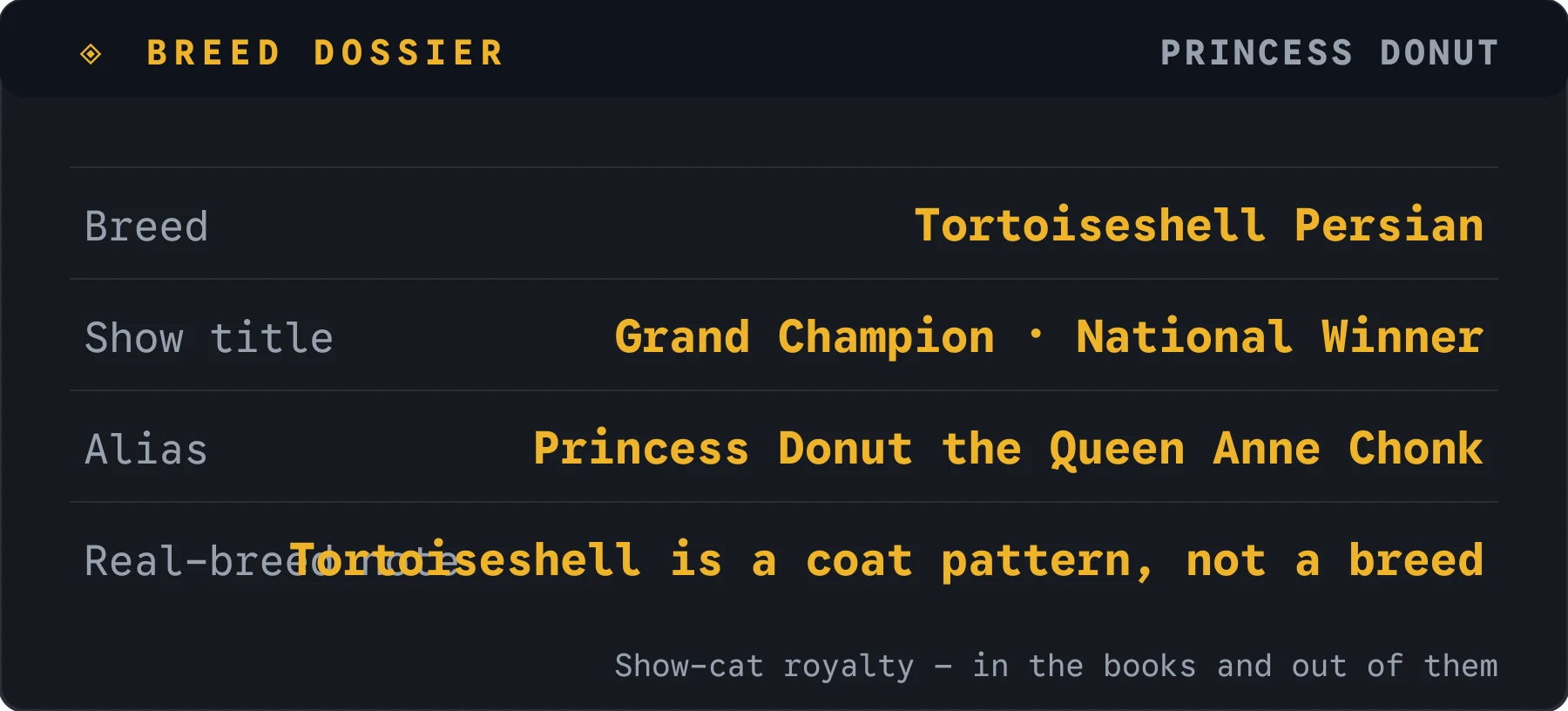
In the books, Donut is explicitly a tortoiseshell Persian — and not just any tortoiseshell Persian, but a decorated one. Before the apocalypse, she was Shannon’s pampered show cat, holding the kind of title wall serious breeders dream about: Grand Champion, Breed Winner at the regional level, and National Winner. Fans know her by her official competition name, Princess Donut the Queen Anne Chonk, which doubles as the best joke title in modern genre fiction.
The series wiki’s Donut entry catalogs her complete title wall for the curious.
Every detail of that backstory tracks with real cat-fancy culture. Persian show cats genuinely compete through regional circuits toward national rankings, and their owners genuinely treat the hobby with the intensity Donut parodies. When she leverages fame, sponsors, and fan loyalty as survival tools inside the dungeon, Dinniman is writing what he knows: show animals are already performers. The dungeon just gave Donut a bigger audience.
New to the series? Donut appears from the first chapter of book one. Our full character guide covers her class, abilities and story role; this page focuses on the real-world breed.
Tortoiseshell Is a Pattern, Not a Breed
Here is the detail most new fans miss: “tortoiseshell” describes a coat pattern, not a breed. A tortoiseshell cat has a mottled coat of two colors — black-based patches blended with orange/red ones — produced by genetics we will get to below. That pattern can appear across many breeds and countless random-bred cats. So “tortoiseshell Persian” means specifically: a Persian-breed cat (long flowing coat, flat pushed-in face, cobby body) wearing the tortoiseshell coloration.
That combination is real but relatively uncommon compared to classic silver and golden Persians that dominate show rings. Patches of ginger, cream and black swirled through a Persian’s long coat make each tortie visually unique — no two coats are ever identical, which is part of the pattern’s mystique among fanciers.
Why Almost All Tortoiseshells Are Female
The genetics behind the pattern produce the fandom’s favorite piece of trivia. The genes for orange and black coat color sit on the X chromosome. Female cats carry two X chromosomes, so they can express both colors simultaneously — the mottled patchwork that defines tortoiseshell. Male cats, with one X and one Y, can generally express only one of the two colors.
The rare exceptions are male tortoiseshells with an extra X chromosome (XXY), which occur roughly once in every few thousand torties and are typically sterile. So if you meet a tortoiseshell cat, the odds are overwhelming it is a girl — fitting for a queen like Princess Donut, whose entire personality assumes she is the main character of any room she enters.
For readers who want the genetics in full detail, the Wikipedia overview of tortoiseshell cats covers the inheritance studies behind the pattern.
Some fans also use the term calico interchangeably with tortoiseshell. They are related but distinct: calicos show distinct white patches alongside the orange and black, while true torties blend the two colors without significant white. Depending on how much white a patched Persian carries, it may be called a tortoiseshell-and-white or calico by different registries.
Real Tortoiseshell Persian Temperament vs. the Donut Experience
Persians as a breed are famously calm, indoor-oriented companion cats — quiet voices, gentle play, and a strong preference for predictable routines and luxurious napping surfaces. Add the folk reputation of tortoiseshell-patterned cats, often called “tortitude”: a perceived streak of sass, independence, and strong opinions. Science has not confirmed that coat color drives personality, but ask any tortie owner and you will hear stories.
Map that onto Donut and the parody writes itself:
- Show-ring confidence → Donut treats every dungeon broadcast like a ring appearance, because she has literally been judged her whole life
- Persian grooming needs → a longhaired flat-faced cat demands daily care, and Donut expects others to acknowledge the effort
- Tortitude → her imperious demands, grudges, and diva negotiations are tortitude weaponized for survival
- Breed-typical attachment → beneath the theatrics, Persians bond deeply with their people, just as Donut’s loyalty to Carl proves under pressure
In other words: the books work because Donut is a believable cat. Anyone who has lived with a spoiled longhair recognizes her instantly.
Should You Get a Tortoiseshell Persian?
If Donut inspired you to look into the breed, go in clear-eyed about the responsibilities:
- Grooming is daily. Persian coats mat quickly without committed brushing, plus regular face-fold cleaning for flat-faced lines.
- They are strictly indoor cats. Persians are bred for companionship, not survival — the exact opposite of their fictional dungeon counterpart.
- Health screening matters. The breed’s flattened face can accompany breathing and tear-duct issues; responsible breeders screen for polycystic kidney disease as well.
- Buy ethically or adopt. If you want a specific look like a tortie Persian, work with reputable breeders who health-test and let you meet the mother cat — or check breed-specific rescues first.
- Never buy on impulse from an unverified seller. This applies double online, where every popular franchise spawns lookalike pet sellers. The same skepticism we recommend for official merchandise applies to living things.
And a gentle reality check: a real tortoiseshell Persian will not talk, cast spells, or negotiate sponsorships. You will, however, absolutely believe she is judging you — some things come standard in the breed.
FAQ
What kind of cat is Princess Donut?
A tortoiseshell Persian show cat — formally titled Princess Donut the Queen Anne Chonk, Grand Champion and National Winner before the world ended.
Are tortoiseshell Persian cats rare?
Uncommon rather than rare. The tortoiseshell pattern appears in Persians less often than silver or golden coats, and nearly all tortoiseshell cats are female due to X-chromosome genetics.
Do tortoiseshell cats really have “tortitude”?
It is folklore rather than proven science — but a widely repeated one. Owners consistently report sassy, opinionated personalities in tortie-patterned cats, which is precisely the trait Dinniman exaggerated into Donut.
Is Donut based on a real cat?
Matt Dinniman has not tied her to one specific animal publicly. What is certain is how accurately the show-cat culture — titles, circuits, breeder pride — mirrors the real cat fancy world.
Could a cat like Donut survive a dungeon crawl?
Absolutely not, and she would be the first to say the dungeon should be honored she tried.