Dungeon Crawler Carl, Book 4: The Gate of the Feral Gods — The Complete Guide
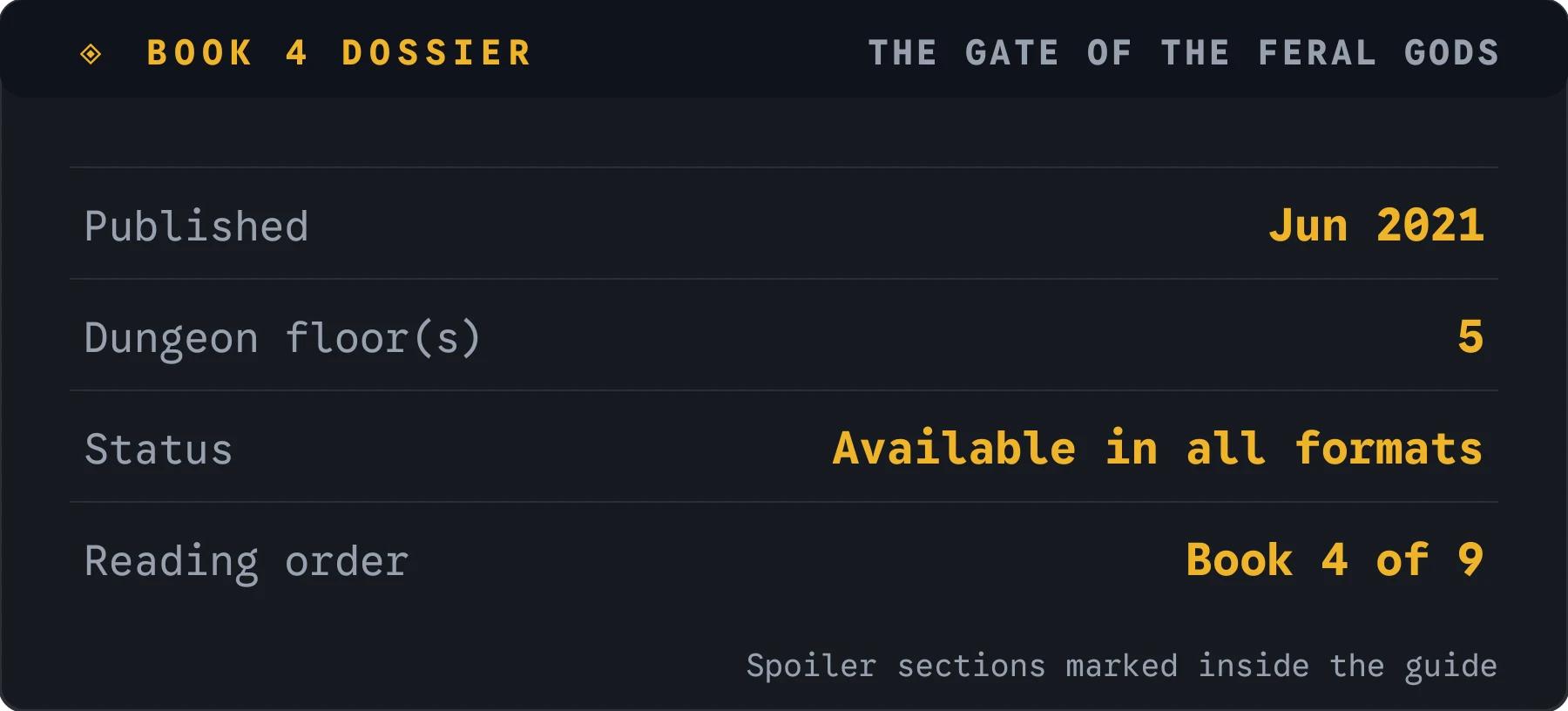
The Gate of the Feral Gods, published June 14, 2021, is where Dungeon Crawler Carl stops being about surviving a floor and starts being about what kind of person survives. Floor 5 escalates the crawl to god-tier stakes, the ensemble’s politics detonate, and the book quietly assembles the emotional machinery the entire endgame runs on.
It is also — per its Goodreads and community reception — the point where skeptics fully convert. This guide covers what book four does and why readers rank it among the series’ best.
The Setup (Spoiler-Free)
Floor 5 widens everything: the dungeon’s scope, the factions’ ambitions, and the consequences of the choices made on the train floor. The feral gods of the title signal the escalation — the opponents are no longer merely dangerous, they are mythological, and the crawler politics surrounding them have hardened into genuine power blocs.
Carl’s faction, built from misfits and handoffs, now has to function as one. The book’s drama comes from that strain: alliances forged in survival get tested by strategy.
Books four’s second half carries the series’ biggest mid-series events — including a death that reshapes the cast. Spoiler boundaries are marked, but this guide assumes book four completion below the break.
Imani’s Book: Station 36
Book four belongs as much to Imani as to Carl. The Station 36 defense — her coordinated stand during the Floor 4-to-5 crisis — is the ensemble’s proving ground, and it makes the series’ argument explicit: the healer who organizes is worth more than the damage-dealer who grandstands.
Her Obsidian Butterfly wings’ Constitution aura, her triage discipline, her Fire Spiritualist zone control — Station 36 is where the build pays off, and it is the sequence new readers most often cite as the moment they stopped skimming and started caring about every member of the cast.
The Floor 4 Break: Hekla and Katia
The other detonation is personal. The consequences of Hekla’s Floor 3 handoff and her secret machinations against Katia Grim come due in book four, ending in the confrontation the fandom still argues about: Hekla — the #2-ranked crawler, the psychiatrist who weaponized a persona — dies on Floor 4, accidentally killed by Katia in a fight Hekla’s own deceptions engineered.
Nobody wins the scene. The books frame it as the leaderboard’s paranoia machine consuming one of its best optimizers, and they let Katia carry the weight forward — into her Doppelganger transformation’s full flowering, into Team Katia, and into the Royal Court politics of the later books.
Full spoiler territory: the specifics of the confrontation, and Katia’s exact role, are among the series’ most-discussed scenes. Experience them in the text.
Why Readers Rank Book Four So High
- The escalation is earned. The feral-gods stakes grow from seeds planted in books one through three.
- The ensemble gets its showcase. Imani, Katia, and the extended crawler cast all receive defining material.
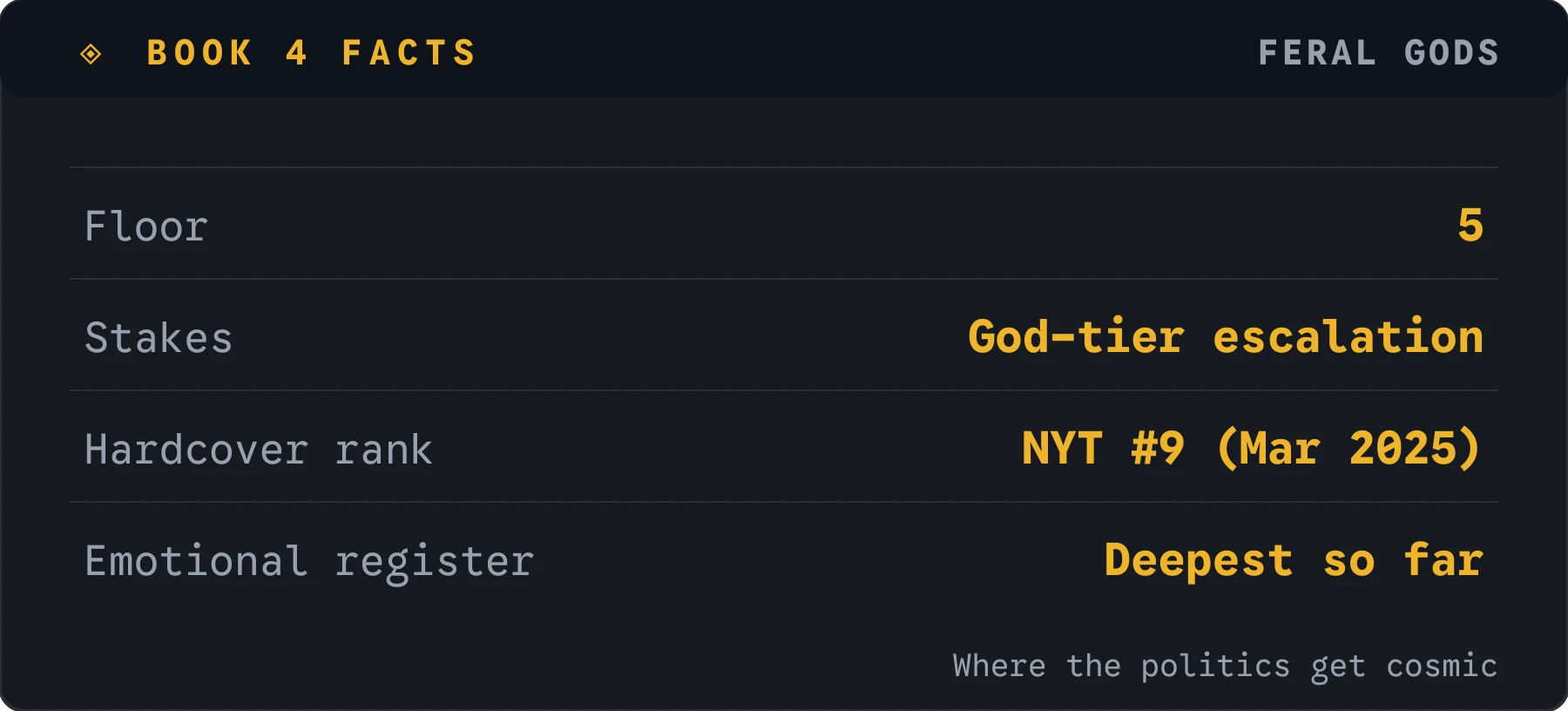
- The commercial proof matched: the Ace hardcover edition hit #9 on the New York Times Hardcover Fiction list (March 2025) — mainstream-market confirmation of the series’ crossover.
How It Connects
- Backward: the train floor’s fallout (book three) and the Floor 3 handoff (book two) both come due here. Context in our book 3 guide.
- Forward: Floor 5’s resolution sets the stage for book five, The Butcher’s Masquerade — the action high-water mark — and its political fallout echoes through book seven’s award-winning run.
Formats
Kindle (author-published), Ace paperback/hardcover (March 11, 2025 re-release with bonus novella passages), and the Jeff Hays audiobook via Soundbooth Theater. Edition trade-offs are covered in our reading order guide.
FAQ
Is book 4 the best in the series?
It is on many fans’ shortlists — see our books ranked guide for the full community picture. Book five and book seven are its main competition.
Does Hekla really die in book 4?
Her Floor 4 fate is one of the series’ defining mid-series events, and the fandom’s most debated scene. If you are not current, stop here — our Hekla profile handles it with full warnings.
How long is book 4?
Longer than the early entries, with the audio edition running well past the first book’s 13 hours. The series’ books grow with each floor.
Where can I verify details?
Wikipedia’s series entry documents the NYT rankings and publication data; Goodreads carries the reader reception.
The Feral Gods’ Design Philosophy
Floor 5’s escalation is worth studying as craft. The previous floors taught rules; Floor 5 introduces entities that predate the rules, and the book uses that asymmetry to shift the series’ genre register — from survival thriller toward mythic conflict — without breaking its own logic. The gate of the title is literal, but the crossing is thematic: the crawl stops being a game show with death and becomes a war with a broadcast budget.
For the ensemble, book four is the great redistribution of narrative capital. Imani’s Station 36 command, Katia’s transformation, and the faction fallout redistribute competence and consequence across the cast — deliberately, so the endgame books can run large-scale conflicts without deputizing strangers. Readers who wonder why books seven and eight can sustain huge ensemble set pieces are seeing the compound interest on book four’s character investment.
The reception data backs the craft: the Ace hardcover’s NYT Hardcover Fiction ranking (#9, March 2025) made book four the series’ first mainstream-hardcover data point. Per Goodreads and Wikipedia.
Reader Notes for Book 4
Emotional pacing note: book four alternates spectacle and grief more than any earlier volume. Readers sensitive to character deaths should know the fandom considers this the series’ first “keep tissues nearby” entry.
Data note: the Ace hardcover edition of book four reached #9 on the NYT Hardcover Fiction list in March 2025 — per Wikipedia — a useful fact against anyone claiming the series is niche.
Companion reading: the Imani profile and Katia profile cover the two arcs this book defines.