Dungeon Crawler Carl, Book 3: The Dungeon Anarchist’s Cookbook — The Complete Guide
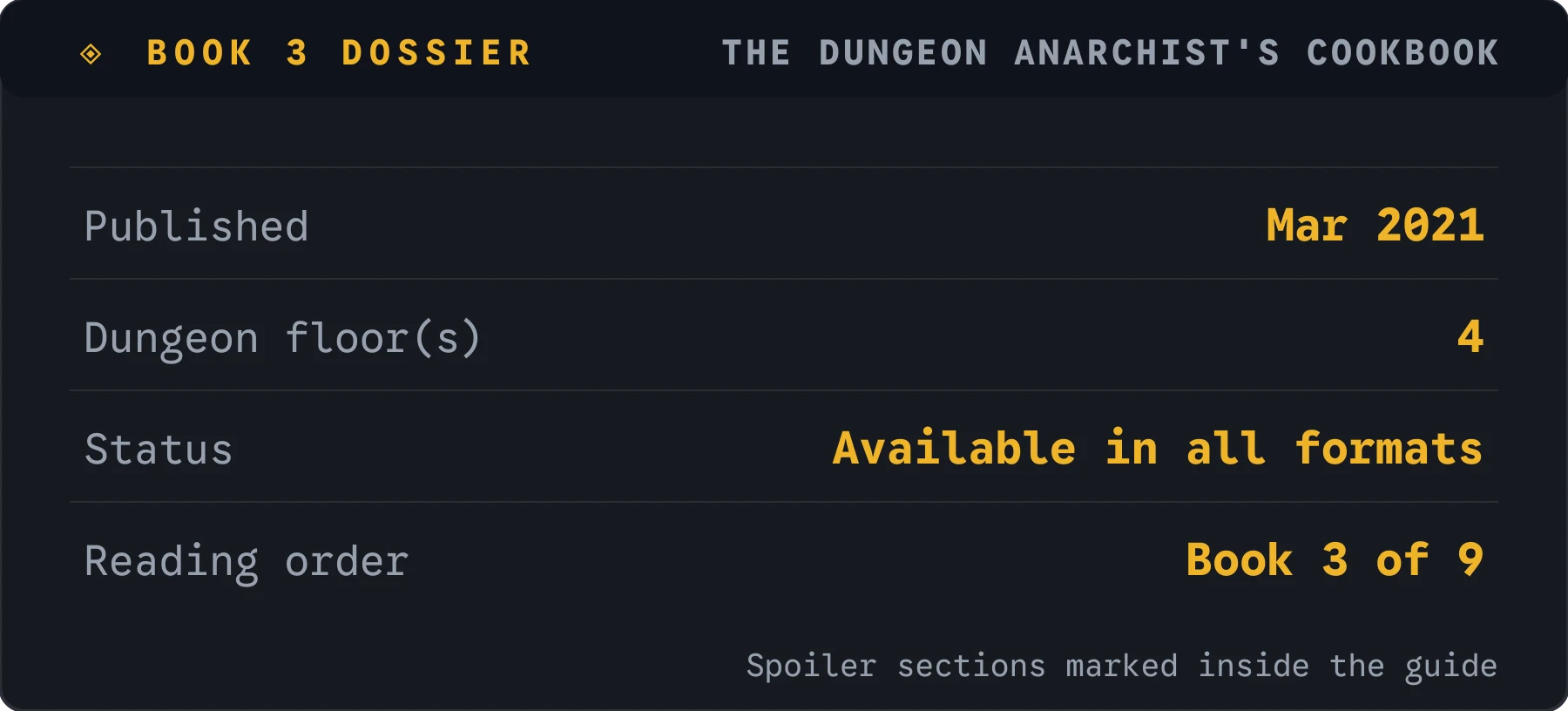
The Dungeon Anarchist’s Cookbook, published March 19, 2021, is Dungeon Crawler Carl’s structural wild card. Floor 4 — the infamous train floor — abandons the series’ established geometry for something stranger and more dangerous, and the book takes its name from the in-universe resistance manual that becomes central to Carl’s long war against the Borant Corporation.
It is also the series’ most debated entry: the book some fans call their favorite and others call their least — usually for the same reason. This guide explains what it does, why it matters, and how to read it.
The Setup (Spoiler-Free)
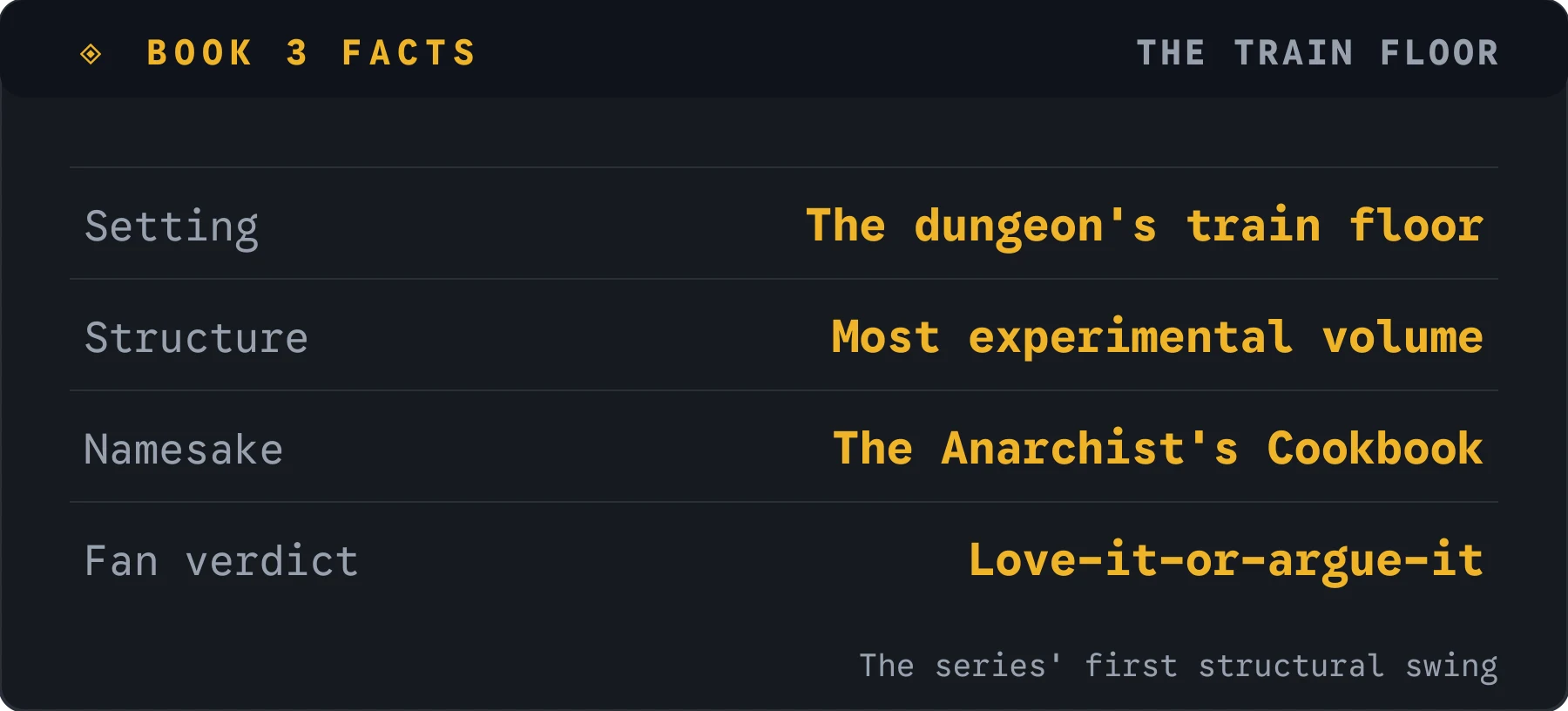
Floor 4 is the Iron Tangle — a train-based floor whose mechanics break from everything floors one through three taught crawlers to expect. The dungeon’s designers, chasing ratings through novelty, built a floor that plays by its own rules, and the crawlers who survive it are the ones who adapt fastest.
For Carl, the floor delivers the book’s namesake: the Dungeon Anarchist’s Cookbook, the underground manual of crawler resistance whose history and authorship become one of the series’ great long-running threads. What he learns from it reframes the crawl — not as a game he is winning, but as a war other crawlers have been fighting for generations.
The Experimental Structure
Here is the honest part: book three is structurally the series’ biggest swing. The train floor’s logic is deliberately disorienting, the pacing fragments to match, and readers who binge the first two books in a weekend sometimes hit this one like a wall.
The fandom’s consensus has softened over time — re-readers tend to love it, because knowing where the series goes makes the train floor’s chaos feel intentional rather than messy. First-time readers should know two things: the confusion is designed, and the payoff compounds for books to come.
If book three is grinding you down: push through, or listen to the audiobook — Jeff Hays’s performance smooths the structure’s sharp edges considerably. See the audiobook guide.
The Cookbook’s Origin Story
The book’s title refers to the in-universe manual compiled by crawler resistance across multiple seasons of the dungeon. Its history is the series’ deepest lore vein: previous crawlers, previous floors, previous seasons — proof that Carl’s war predates him and will outlast him unless he changes its terms.
The cookbook’s seventh edition carries a contribution that has become series legend: a single entry by a crawler named Volteeg, a gargoyle who appears in person much later — and whose entry is not a strategy at all, but a lament. The cookbook remembers people, not just plans. Book three is where that idea takes root.
Katia’s Integration
Floor 4 is also where Katia Grim — handed to Carl’s party at the end of book two — stops being Hekla’s favor and starts being family. Her shapeshifting develops meaningfully here, and the purple-mohawk era of her evolution begins. The book quietly does the character work that makes book four’s detonation land.
Reception: Divisive, Then Vindicated
Community rankings consistently place book three at the center of DCC’s most passionate arguments — see our books ranked guide for the full tier picture. The pattern that emerges from thousands of reader reviews:
- First-read rankings dip here for a meaningful share of readers.
- Re-read rankings recover sharply — the floor rewards knowing what matters.
- Almost everyone agrees the cookbook lore is essential, however they feel about the train.
How It Connects
- Backward: the cookbook reframes everything book two’s politics established — the leaderboard, the factions, the broadcasts. Start with our book 2 guide.
- Forward: Floor 4’s arc continues directly into book four, The Gate of the Feral Gods, where the train’s consequences catch up with everyone.
Formats
Kindle (author-published), Ace paperback (March 11, 2025 re-release with bonus novella material), and the Jeff Hays audiobook via Soundbooth Theater — the audio edition is the recommended vehicle for this particular floor. Publication data per Wikipedia and Goodreads.
FAQ
Is book 3 skippable?
No. It introduces the cookbook — arguably the series’ central lore object — and Katia’s integration. Skipping it breaks books four through eight.
Why do fans argue about it?
The train floor’s experimental structure divides readers on first read. The re-read consensus is warmer: what felt like chaos reads as design once the endgame books reveal the plan.
What is the Anarchist’s Cookbook in the story?
An underground manual compiled by crawlers across dungeon seasons — resistance doctrine for fighting the system rather than playing it. Its authorship history is a multi-book mystery.
How long is book 3?
Shorter than later entries but longer than book two, at roughly 380 pages in the original self-pub edition. The Ace re-release adds the Pineapple Cabaret passages.
The Cookbook’s Real-World Echo
The Dungeon Anarchist’s Cookbook works as lore because it has a recognizable shape: it is a zine, a wiki, a GitHub repository of resistance — compiled anonymously by people who will not benefit from署名, distributed to strangers who will. Readers from open-source and mutual-aid backgrounds recognize the form instantly, and the books honor it: contributions are credited, entries are argued over, editions matter.
Volteeg’s single entry — the lament — is the device that elevates the concept from world-building to theme. It establishes that the cookbook’s authors are documenting costs, not just tactics, and it makes every later use of the manual feel weighted. When the series’ endgame leans on cookbook doctrine, the emotional bill from book three comes due.
New readers should also note what the cookbook does to the series’ structure: it gives Carl’s faction a curriculum. From book three forward, the party’s growth is partly institutional — they are not just leveling, they are inheriting an organization. That inheritance is why the endgame books can scale the way they do.